
Agillence Supply Chain Designer (ASCD)
ASCD is a supply chain design tool, especially powerful where your business requires multi-stop shipments. It optimizes simultaneously multi-stop route territory (outbound from warehouses) and upper echelon supply chain together.
Multi-Stop & Multi-Echelon Network Flow Optimization
ASCD Network Flow Architecture
Multi-Stop Optimization
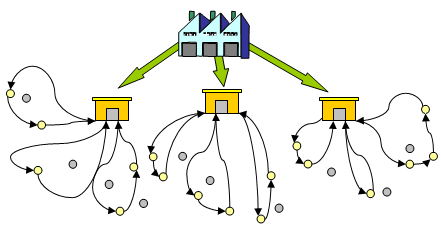
Simultaneous Echelon Trade-Offs: ASCD models the simultaneous trade-offs between inbound supplier logistics, distribution center warehousing/inventory carrying expenses, and outbound multi-stop delivery routes with strict delivery cadence requirements.
ASCD is a tool to design supply chain network optimizing several cost factors while respecting various constraints such as capacities. A simple example, but challenging as shown in the picture above, is to trade off inbound costs, warehousing/inventory carrying costs at DC’s and outbound costs where outbound involves multi-stop routes with delivery frequency requirements. To have an implementable solution, it is essential to model multi-stop delivery cost accurately considering delivery frequency requirements.
The following questions can be answered by ASCD:
- How many facilities do I need and where?
- Where do I put new facilities and what should be their sizes?
- How do I rationalize combined supply chain networks?
- How robust is my supply chain under various assumptions?
- What’s the impact of higher or lower customer service?
- Where should I package my products?
- Do I need one layer or two layer distribution?
- Which customers should be served by which DC?
- Which customers should be served by which route?
- Which suppliers should I work with?
Geographic Network Design & Territory Mapping
Strategic Supply Chain Network Topology
Geographic Optimization
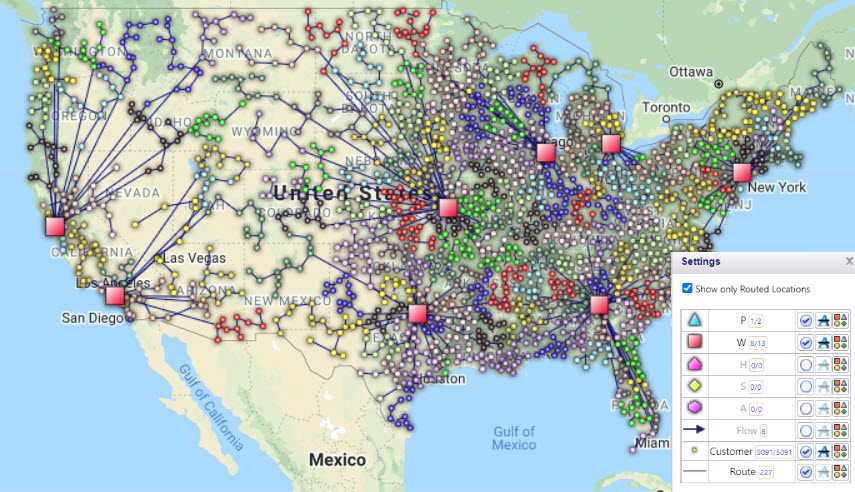
Strategic Territory & Facility Allocation: Visualizing regional warehouse territories, multi-stop customer clusters, and transportation corridors across North America and global manufacturing networks.
Key Features
- Multi-stop and delivery frequency modeling for lower echelon outbound logistics
- Unlimited echelon, lateral or reverse flow: Complex networks without topology constraints
- Unlimited cost breaks: Unlimited piecewise linear cost structures matching real freight tariffs
- Complex process relationship within a facility: Internal processing stages, throughput limits, and space allocation
- Separate modeling of warehousing costs and inventory carrying costs for true landed cost visibility
- Easy baselining: Rapid calibration of current operational state for accurate scenario comparisons
- Intuitive scenario management facilitates collaboration between groups of users
- SaaS and Cloud based scalable & secured enterprise platform with concurrent scenario optimization